Sotkajärvi
The Road North
Kalevala, Runes 6 and 7
Joukahainen came home from the swamp and did not get over it.
He got over the wet, and the moss in his teeth, and the loss of a good sledge. What he did not get over was that his sister walked into the sea rather than marry the man he had promised her to, and that the man had never even had to try.
So he built a crossbow. It took a while. He carved a horse on the back of it and a foal on the arc and a hare on the string, which is a great deal of decoration for a thing with one job. His mother asked what it was for. He told her. She told him not to: kill Väinämöinen and the joy goes out of the world, the singing goes out of the world, and nothing is left that is worth listening to.
Joukahainen said he had considered that and was doing it anyway.
Then he waited by the water. Waited through morning, through midday, through evening. Waited so long his mother asked why he never brought home any game, and he did not answer.
Then one morning something came across the water out of the north, blue against blue, and it was an old man on a blue elk of a horse riding on the surface of the sea, because that is a thing he can do.
Joukahainen drew.
His mother appeared at his shoulder and told him, urgently, not to shoot the man. Shoot the horse. Take the horse and leave the man, and at least the world keeps its songs.
He shot three arrows. The first went high and split the sky. The second went low and went into the earth. The third took the blue horse under the left foreleg.
Väinämöinen went into the sea.
Here is where the greatest singer in the world spends the next eight days. Not singing. Swimming. The wind takes him east, then west, then out into open water with no land in any direction, and he floats there long enough to start thinking, in some detail, about how a man drowns, and to feel considerably sorry for himself.
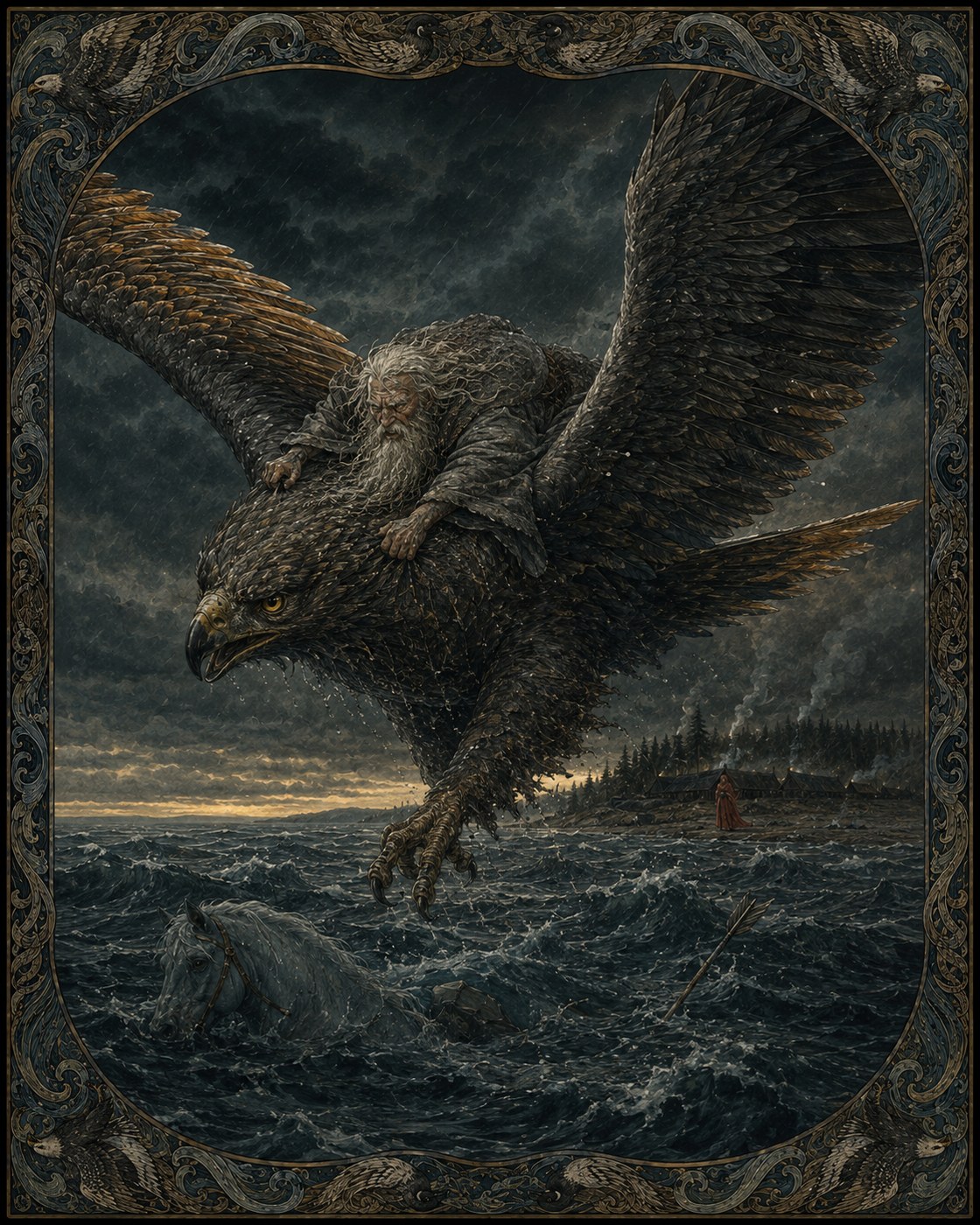
Then an eagle came down.
The bird asked what he was doing in the sea, and he explained at length, as he does. Then the eagle explained itself. Years ago, when men were burning a field clear, they left exactly one birch standing so that the birds would have somewhere to rest. That was you. Get on.
It carried him north and set him down on the shore of Pohjola, which is the last place on earth he wanted to be. It is cold there, nothing is his, and the dogs bark at him.
So he sat on the beach and wept. This is not a figure of speech. He cries for three days, loudly, and it is what saves him, because a servant girl hears it across the water and goes to fetch her mistress.
Louhi runs the North. She came out in her boat, brought him in, warmed him, fed him, and asked what a great man was doing crying on her beach. He said he wanted to go home.
She said: I can send you home. Horse, sledge, food for the road, and one of my daughters besides.
And then the terms. Forge me a Sampo. A mill with a lid of many colors, made from the tip of a swan's quill, the milk of a barren cow, one grain of barley and the wool of a single summer ewe. Do that and you go home rich.
Väinämöinen, who cannot make one, said the honest thing in the most useful possible way. I cannot. But I know a man who can. Ilmarinen the smith. He hammered out the sky itself, and to this day nobody can find the mark of the hammer on it. Send for him and you will have your Sampo.
Louhi took the deal.
So the old man got his sledge and his horse and his road home, on the condition that he hand over his closest friend to a woman in the North who wanted something built.
He was told, on the way out, not to look up at the sky.
He looked up at the sky.
Runes 6 and 7