Sotkajärvi
The Singing Match
Kalevala, Rune 3
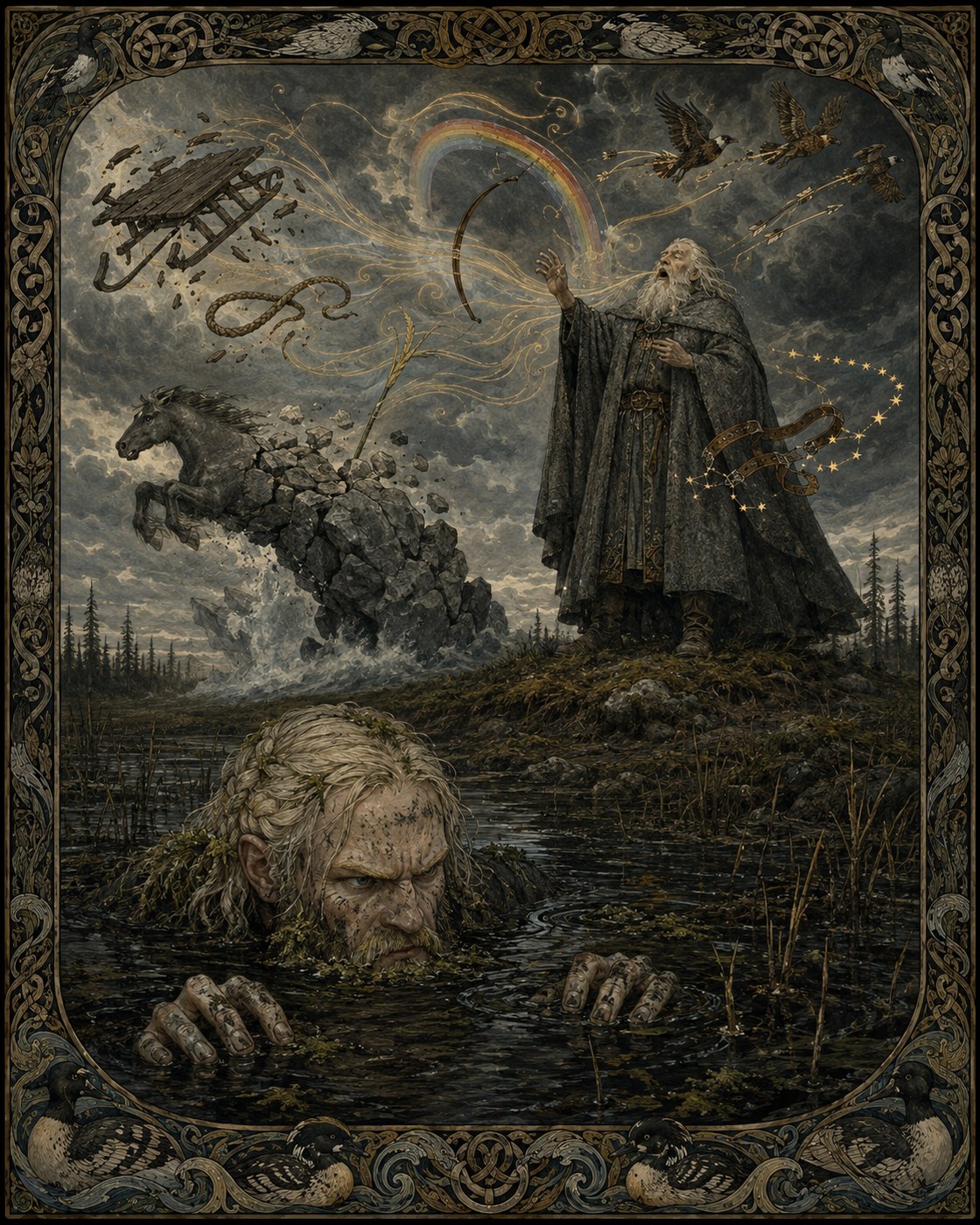
Joukahainen was young, and he had heard about Väinämöinen.
That is really the entire cause of the incident. Somewhere up north a boy heard that down in Kalevala there was an old man supposed to be the finest singer alive, and the boy formed an opinion about that, and the opinion was: says who.
His mother told him not to go. His father told him not to go. They pointed out, with the patience of people who have made this argument before, that the old man would sing him into a swamp. Joukahainen replied that his father was a poor singer and his mother was worse, and that he intended to go south and sing the shoes off the old man's feet.
He hitched a sledge and drove for three days and rammed straight into Väinämöinen on the road, because he was not going to be the one who pulled over. Shafts locked. Traces tangled. Steam coming off both horses.
"Who are you," said the old man, mildly, "that you drive like a fool."
Joukahainen gave his name, and then his terms: they would sing at each other, and whoever knew less would give way. Väinämöinen said he was not much of a singer, but go on then.
So the boy sang what he knew. He sang that a roof has a smoke hole. That fire is hot and water runs downhill. That a pike spawns in the cold and a stone is old and a kettle boils and a pine grows tall. It was all perfectly true. It was also the sort of thing you can learn by standing outdoors for a year.
Väinämöinen's assessment, roughly: this is children's knowledge, women's knowledge, not the knowledge of a bearded man. Tell me the deep origins of things.
And Joukahainen, sensing he was losing, made the decision that ruins him. He claimed he had been there at the beginning. He said he had helped plow the sea and sink the sea rocks, that he had set the sky in place, steered the sun, hung the stars.
This was a lie, and he told it to the one man alive who had actually been present.
Väinämöinen did not argue. He sang.
The lakes stood up. The hills split. The stones in the fields cracked open. And the boy's sledge came apart around him piece by piece as the song went through it, each part turning into something else and leaving. His whip became a reed on the shore. His horse became a boulder in a rapid. His gold-hilted sword went into the sky as lightning. His bow became a rainbow. His arrows became hawks. His dog became a stone, his cap became a cloud, his gloves became water lilies, his coat became weather, and his belt went up as a scatter of stars.
Then the song reached Joukahainen himself, and Joukahainen began to go down.
Into the fen to the waist. Into the moor to the armpits. To the chin. Moss in his mouth, beard dragging in the mud, and the old man still singing.
So the boy started bargaining. Two crossbows, he said, one good and one better. Väinämöinen kept singing and the boy sank another inch. Two boats, then. Two stallions. Gold. Silver. His father's hats full of it. His fields, his farm, everything he would ever inherit.
Nothing. Down another inch. Water at his lip.
Finally Joukahainen said: take my sister Aino.
The singing stopped.
The old man was, by his own account, extremely pleased. He accepted at once, sang the boy back up out of the moss, sledge and horse and all, and sent him home.
Joukahainen arrived wet and shaking and told his mother he had lost his sister in a wager. His mother was delighted. She had always wanted a famous son-in-law.
Aino was not asked. Nobody asks her at any point in the proceedings, which turns out to matter enormously, but not tonight.
Two men argued about who knew more. Neither of them lost anything he could not replace. The bill went to a girl who was not on the road.
Rune 3